Dragon Gliders

Henry, Owen, and I were a little lost for something to do and so we decided to make some wire models. Owen was more interested in using the wire along with a metal rod and a battery to create a magnet which he succeeded at. I don't have a picture, unfortunately. I tried thinking about how to create wire dragons and so got out the Dragonology book. What caught my eye was a glider and so Henry and I made the "dragon gliders" in the photographs. This project requires only wire, twigs, paper, glue, tape, scissors, pruning sheers, a tree, and about 45 minutes of time. (Mom supplied the wire. It is great being married to an artist because for almost any craft project it is very likely she has the materials.)

We walked alone in together time

David Acher's blog had a link to this amazing and scary image editing algorithm. The final sequence of the video might be title "We walked alone in together time."

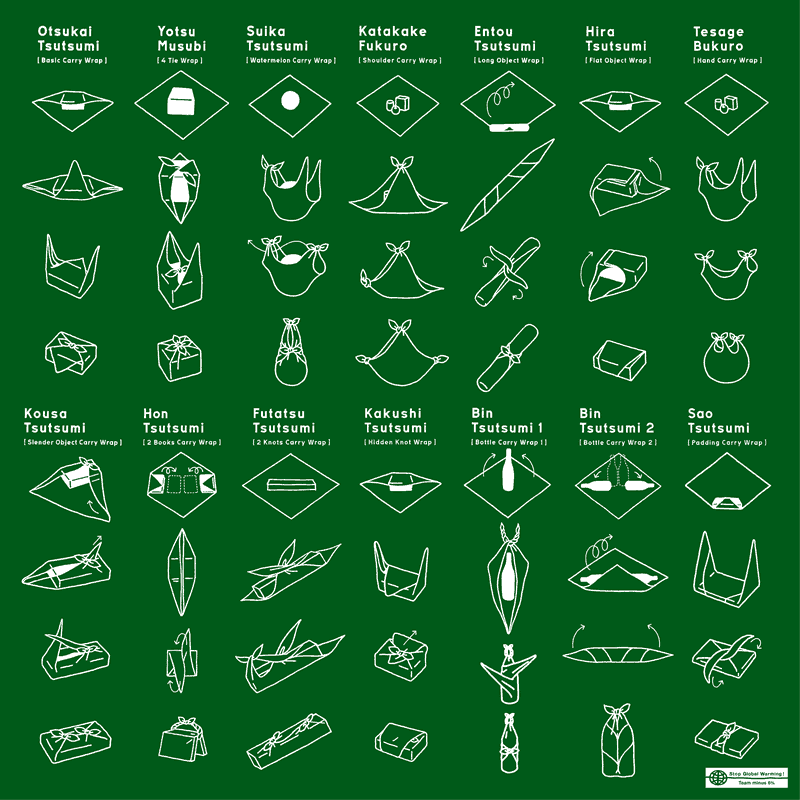
Furoshiki

"Ms Yuriko Koike, Minister of the Environment, has created the "Mottainai Furoshiki" as a symbol of Japanese culture to reduce waste. Furoshiki is a Japanese traditional wrapping cloth which is used repeatedly in a stylish way. (The utilization of this "Mottainai Furoshiki" will contribute to reducing household waste from plastic bags.) The Minister presented the "Mottainai Furoshiki" at the Senior Officials Meeting on the 3R Initiative held in Tokyo, Japan on March 6-8, 2006" (source)

I just don't expect anything like this to come from Dirk Kempthorne, Secretary of the Interior or Samuel W. Bodman, Secretary of Energy. I can't even remember a time when I have heard either of their names in the news. Given the turmoil in US politics right now, perhaps this is good news.

Interaction through detailed printed pages

The Summagraphics SummaSketch II Graphic tablet came today. I have a vague idea for a board game augmented by software with the only interaction being through detailed printed pages. Since I know next to nothing about board game design I am starting with the software and hardware. Hopefully, I will soon learn more about broad game design and embedded systems.
Update: I have no idea where the tablet has disappeared too. Sigh.

From each, according to his ability; to each, according to his need.

Henry & Owen have been helping me look for work. Their suggestions are sincerely given and show how equivalent all work is for children. The two suggestions I like most are waiter at Blue Bird (a local not-so-greasy greasy-spoon) and cashier at Belmont (our favorite local market).

I was a teenager in England during the 1970s and so saw the tail-end of Britain's efforts at socialism. The Labour government and the unions were at war with each other and the people of Britain suffered. The government held firm on wages (sometimes threatening de-nationalization) and the unions hit back with strikes and the hated "sympathy" strikes. So, while my experiences of socialism were not positive, I never blamed the movement but instead the poor execution of it by the new powerful elite, former blue collar works, occupying both government and unions. So, Henry's & Owen's suggestions reminded me of Marx's words "From each, according to his ability; to each, according to his need." Too bad it didn't work out.

Will Code for Money...

I am no longer at Tazz Networks and so am looking for new work. If you know of opportunities please forward the information to andrewgilmartin at yahoo.com. If you want to know more about my skills please see my resume.

Wikipedia needs MAPA

I have been thinking about Wikipedia a bit more than usual recently. Even at "the pond" where Chris and I go with the kids to swim and relax with friends there have been Wikipedia discussions. Thank goodness that I actually pay attention to Geoffrey Bilder's trust del.icio.us links and so I had something to contribute. On the drive home yesterday I was thinking again about Wikipedia and wikis in general and it occurred to me that they need MAPA [1][2].

MAPA is a system for mapping web sites. The mapped pages are hierarchically displayed using orthographic projection and presented using progressive disclosure. That is, MAPA does not try to show everything but instead shows mapped pages around a focal mapped page and you refocus the map by selecting any other focal mapped page. The orthographic projection's two and half dimensions reduce obscuring the map when further annotating or adorning the presentation of the map and mapped pages. This is the visual side of MAPA.

What was equally important to MAPA's success as a map was that it discovered the content's natural hierarchy using David Durand's "organizer". Where the discovery was not quite right, hints could be given to the organizer to re-arrange the hierarchy. What was truly magical was that often only a handful of hints were necessary to map sites as big as ibm.com and javasoft.com (aka java.sun.com). And this is where I think MAPA could really help the Wikipedia. Even if you don't believe knowledge can be strictly organized hierarchically, having some hierarchy would greatly aid anyone orienting themselves within the Wikipedia content after having just jumped there from a Google search result.

[1] "MAPA: a system for inducing and visualizing hierarchy in websites"
http://citeseerx.ist.psu.edu/viewdoc/download?doi=10.1.1.84.5777&rep=rep1&type=pdf
[2] "Applications of Isometric Projection for Visualizing Web Sites" http://www.dynamicdiagrams.com/all_pdfs/idj_10_3.pdf

Doh!

Tazz field trip today! We are off to see the Simpsons Movie this afternoon.


Update: Wait to watch it on TV (its natural environment).

Understanding a Visual

Kirsten Robinson, at Dynamic Diagrams, mentioned how the Calliope Hummingbird visual took time to understand. The understandability of a visual is something we grapple with all the time. It is a subset of the challenge of making a tool that's use is obvious to the user -- or at least to their children. Kirsten knows what she is talking about and so her comment is more about this visual crossing the line between effort needed to learn to use and density of information presented. I think she is right.

The reason I was drawn to it was that the bird's cycles are continuous and so the circle expresses this better than a time-line. It is also hemispheric neutral in that time-lines start in January and finish in December and so for Southern birds their breeding season, for example, might cross the December and January year boundary and so, for those birds you would not see a continuous line but a line in two segments

          Jan Feb Mar Apr ... Oct Nov Dec
nesting   -------                 -------


It is also similar to the situation awareness visuals I have seen [1] and very much like.

Learning how to read this visual is not difficult and so a short audio training might be used. For example, this NPR story [2] is about the movie High Noon's title song and how its elements were repeated in the movie's score. Towards the end of the story there is a short segment of the score featured with overlaid commentary. It is a stunningly informative information presentation. At least to this musical klutz.

[1] "Visual Correlation for Situational Awareness" http://www.sci.utah.edu/publications/yarden05/VisAware.pdf

[2] "High Noon"
http://www.npr.org/templates/story/story.php?storyId=12155282

Presence & Tagging

I want to add centralized tagging to the centralized buddy list of an instant message server. Perhaps personal tagging would be useful but let's start by helping everyone. By tagging a buddy I mean to place them in a group, a team, a project, a location, a department, a title, an interest, etc. My office tags might be
Andrew Gilmartin:
Principle Engineer, Engineering Team, Providence, RI, USA, Narragansett Project, AlphaDog Project, BetaBand Project, Stewie Project, Java Specialty, Concurrency Specialty, User Interface Specialty, Data Model Specialty, Interface Specialty, Gardening Interest, Cooking Interest, Parenting Interest, Board Game Interest, Automata Interest, etc...

My instant message client user interface would then allow me to view staff by any set of tags. Either a small faceted search or a two-level hierarchy. Selecting an account name would start or join a conversation. Selecting a tag would start or join a conference.

IM & Ingenta

When I worked at Ingenta I installed an instant message server and gave everyone in the company an account. I also automatically created everyone's "buddy lists". The buddy list contained everyone's account (in one list ordered by first name), it was fixed (no adding or removing accounts), and was updated with every staffing change.

The server was a great success -- over time. Even the COO logged in each day. Over the course of my work day in Providence, RI (US) I would see the Providence staff's full work cycle of starting their day, going to lunch and coming back, and ending their day. For the Oxford and Bath (UK) staff their day had already begun and so I would mostly see them return from lunch and end their day. For the lone California developer I saw him start his work day just before I headed out for lunch.
And it wasn't just me that saw this but everyone because everyone had the same buddy list.
Read Geoffrey Bilder's posting, "Backchannel", about his experience at Ingenta.


Presence- & Work- Line

General purpose IM clients do not address the needs of a globally distributed team as well as they could. After simple presence information the next important datum is availability (or simply timezone). Within availability having a good sense of the work day is important. This sketch shows the workday (the gray bar), and lunch (blue hatch), where "now" (red line) is for each of three locations


Now replace location with team member names and you have a much better presence indicator.

Thomas Sgouros's Paintings


While buying my morning Cafe Tobe from Coffee Exchange I picked up a post card for a new exhibit of Thomas Sgouros's paintings. His work is atmospheric and stunningly large. If you every get to see his work do so. The Gallery Agniel has some images of this work.

Update: Try here Cade Tompkins Projects.

The Calliope Hummingbird's Year


Looking for an interesting image to use here I discovered this information visual [1] about the molting, breeding, and migration periods of the Calliope Hummingbird. I have heard about the Cornell bird encyclopedia [2] but this is the first time I have seen content from it. I would like to see more; perhaps my library has access to it.

I wonder, do they let you overlay several birds year so you can compare the comings and goings of the population?

[1] http://content.ornith.cornell.edu/ UEWebApp/images/ calliope-hummer-fig-4_6.gif
[2] http://bna.birds.cornell.edu/BNA/

Don't move furniture wearing open-toed shoes

... Ouch.

Canonical's Lunachpad

I recently discovered Canonical's Lunachpad [1]. (Canonical also does Ubuntu.) It is another software engineering management and repository portal. Its focus is not to be the sole owner of information (like, for example, SourceForge and CollabNet are) but to be a consolidator and/or owner of information. Bugs, for example, can be defined and tracked elsewhere and yet have a presence in Launchpad. The same for the code. I have only read the introductory document [2] and poked around so don't know how well it works in practice but it has a great feature set and one I would use on my next open source project.

Even if you are not looking for such a portal it is worth reading about Launchpad's features. I especially like the Blueprints and their rough dependency tracking.

[1] http://launchpad.net/
[2] https://help.launchpad.net/FeatureHighlights?action=AttachFile&do=get&target=launchpad_feature_highlights.pdf

Calliope Sounds

I had a weird moment today. I was walking alone by the highway and heard calliope music. I instantly reached for my cell phone. This was weird because I don't use the sound as a ring-tone but my mind said "cell phone" and "alone" so it must be "mine". The music came from an ice cream truck on the highway. Seems like ring-tones have absorbed all the odd or misplaced musical sounds.